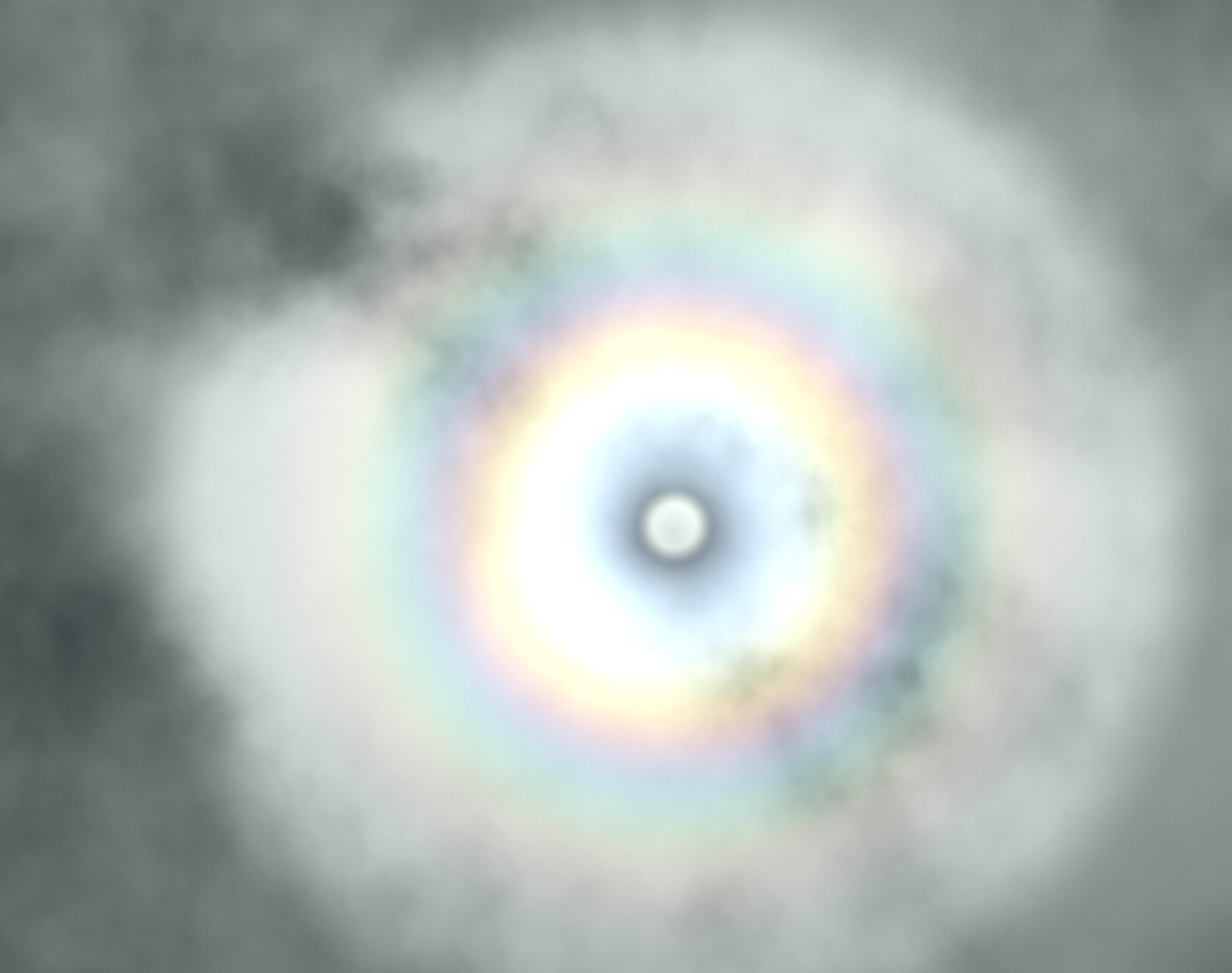
Glories are colorful atmospheric phenomena related to rainbows and coronas. They are commonly seen from aircraft when clouds are present and the sun is on the opposite side of the aircraft from the observer.
I have developed a highly-parallel GPGPU implementation of the Mie scattering equations which accelerates calculation of per-wavelength light scattering. The Mie calculations for each scattering angle and wavelength of light are independent of the calculations for any other, and can be performed simultaneously. My implementation dispatches large groups of these calculations to the GPU to process in parallel. I use a two-dimensional Sobol sequence to sample from (wavelength, scattering angle) space. The 2D Sobol technique ensures that the samples are well-distributed, without large gaps or clumps, thereby reducing the number of scattering calculations needed to achieve visually-acceptable results. The Sobol sampling calculations are also performed in parallel and use a recently-developed technique which precomputes partial results. Overall this work renders atmospheric glories at much faster speeds than previous serial CPU techniques, while maintaining high levels of visual fidelity as measured by both physical and perceptual image error metrics. Additionally, it yields equivalent-quality results with far fewer Mie calculations. The results obtained for glories apply fully or in part to related atmospheric phenomena.
My goal is to produce perceptually-accurate images of atmospheric phenomena at real-time rates for use in games, VR, and other interactive applications.