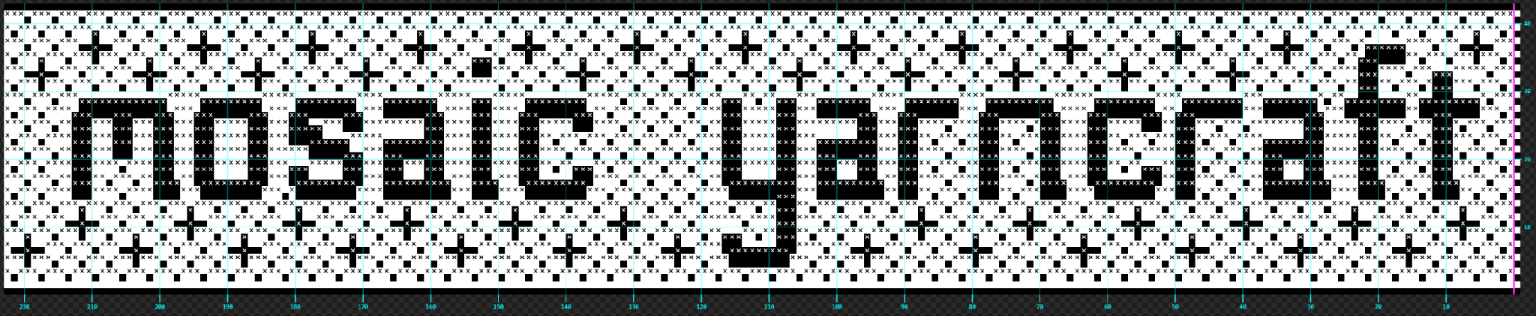
Poster: Craft-Aligned Pattern Design for Mosaic Yarncraft, presented at UIST 2026.
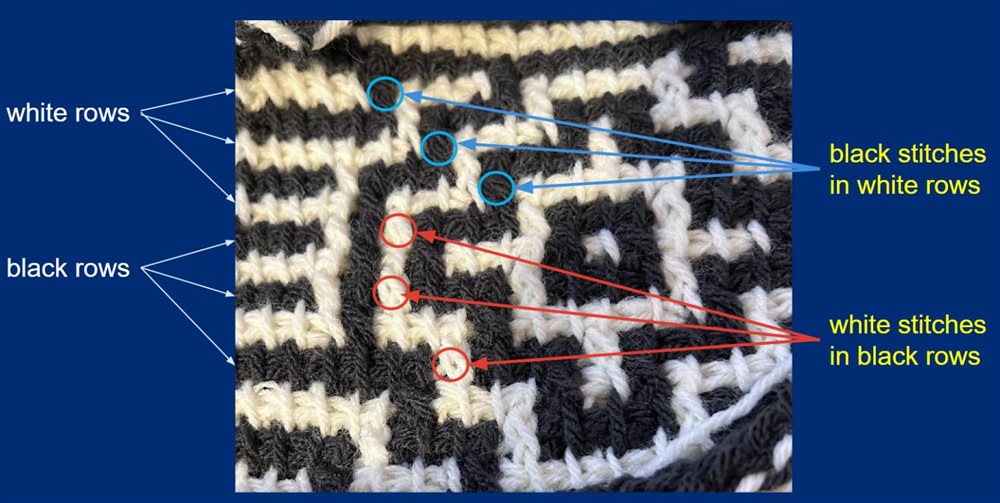
The mosaic colorwork technique for yarncrafts produces intricate multi-colored designs resembling tile mosaics. Unlike most colorwork techniques, each row of a mosaic project is worked in a single strand of yarn. The crafter does not need to carry unused strands across the back of the work or manage numerous bobbins, so stitching progresses quickly and the back of the work shows tidy stripes. Mosaic charts can be used across multiple crafts, such as knitting and crochet.
With this simplicity comes a limit on the design space. Only two colors are used, and each row has a designated color. A "wrong-color" stitch is made by extending and connecting the anchor stitches above and below it, and the anchor stitches must be the correct color for their own rows. Therefore:
Every vertical span of a color must begin and end on rows of that color, and must have an odd number of stitches. Horizontal runs are unconstrained.
Few tools exist for creating charts that meet these constraints, and designing them by hand is tedious and error-prone.
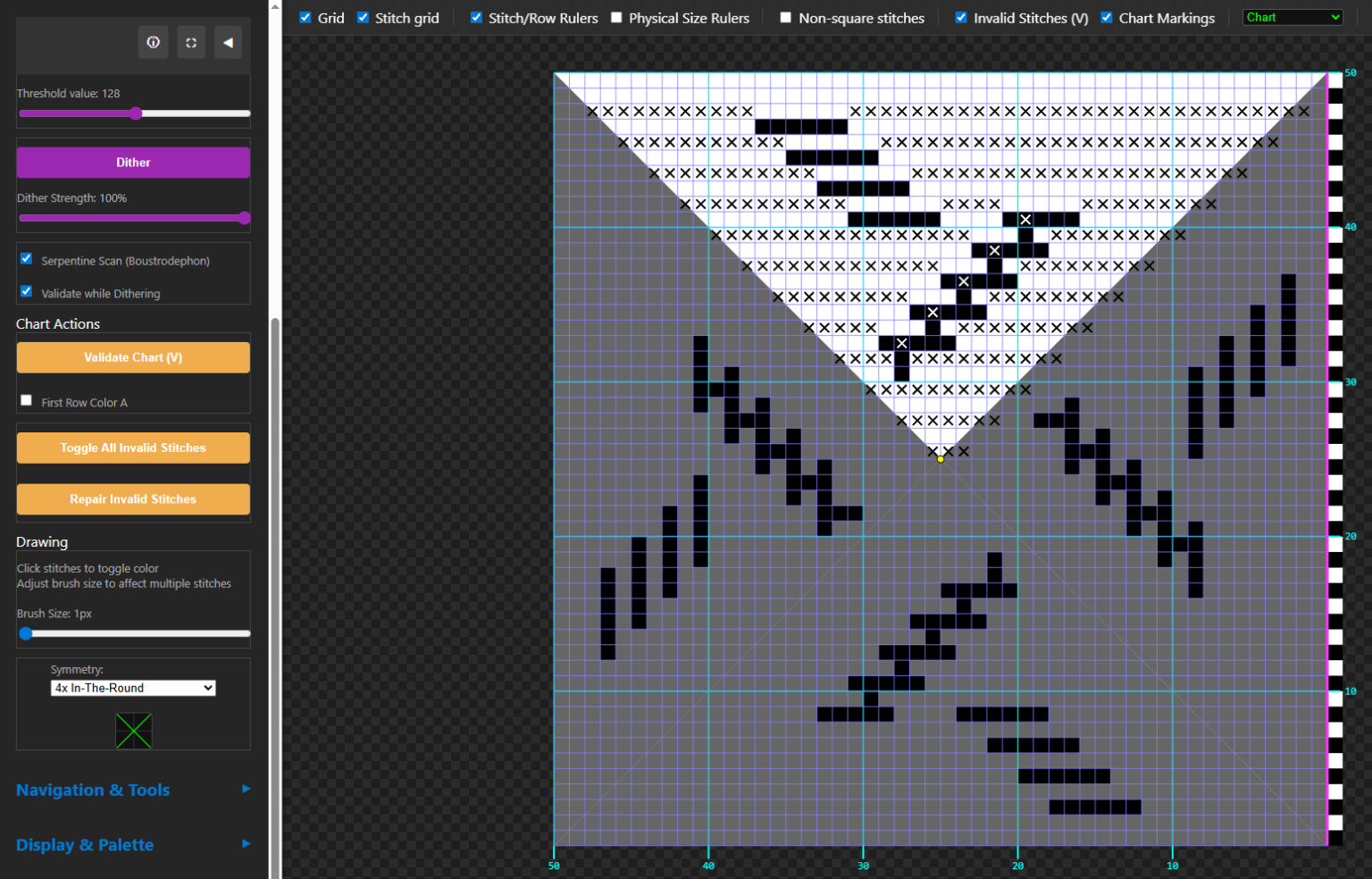
MoYa ("Mosaic Yarncraft") is a browser-based application that helps yarncrafters create mosaic patterns. It combines craft-aligned, guided freehand drawing with image-based algorithms. Continuous chart validation gives immediate feedback so non-compliant designs can be fixed, and chart markup adds craft- and crafter-specific fabrication details.
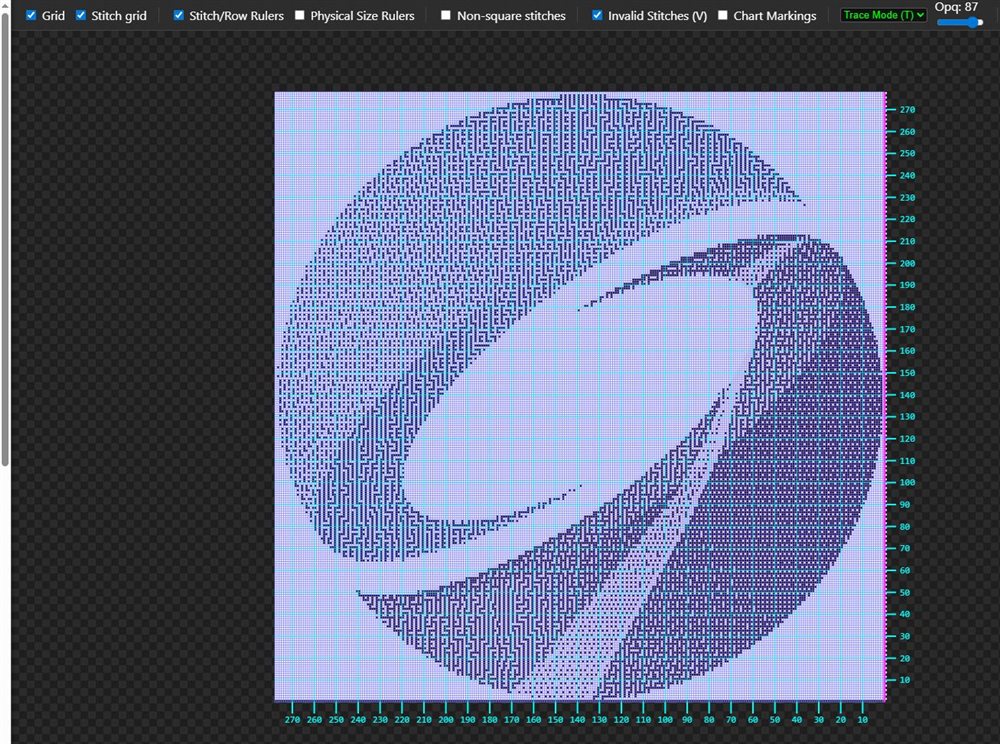
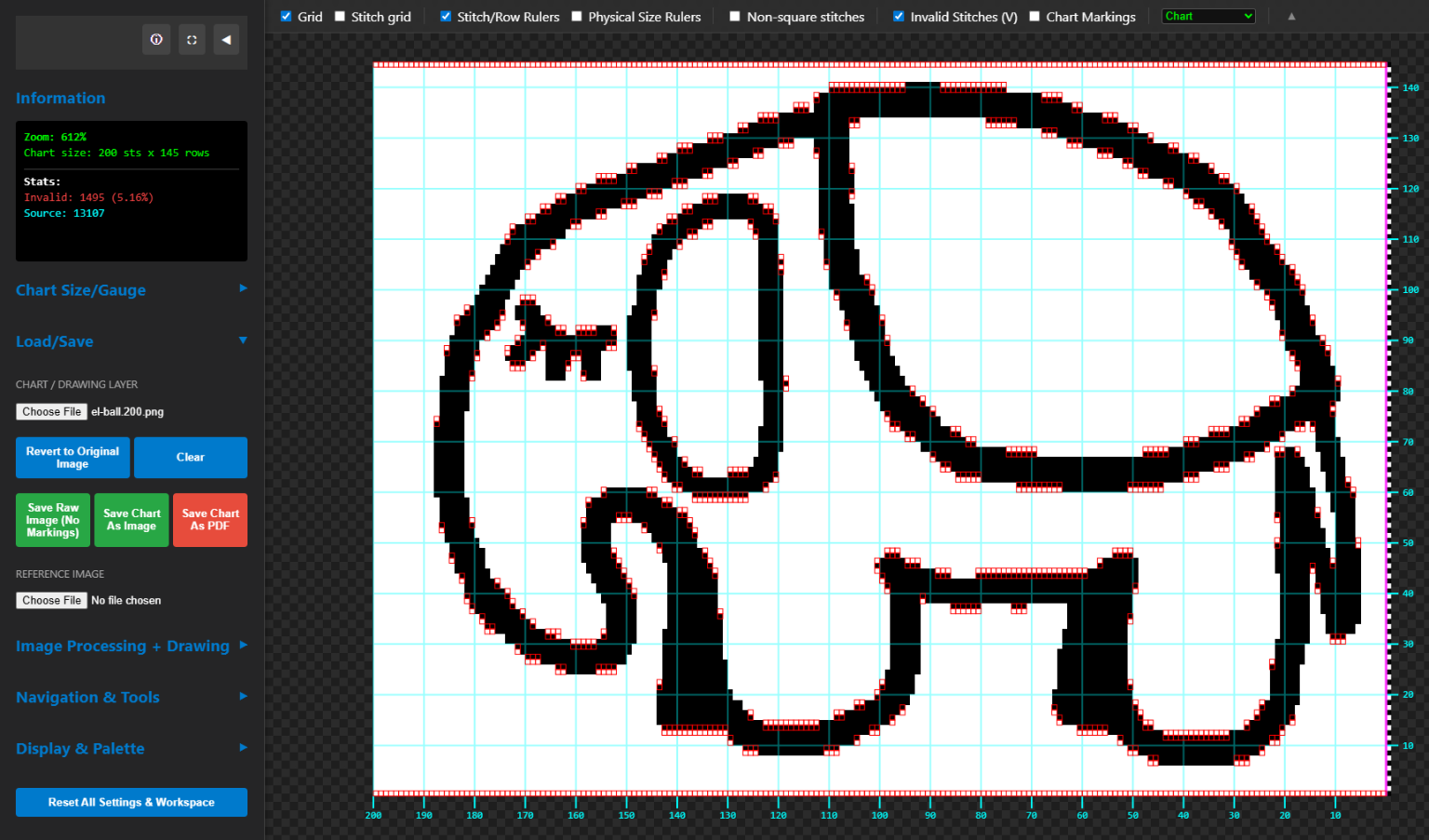
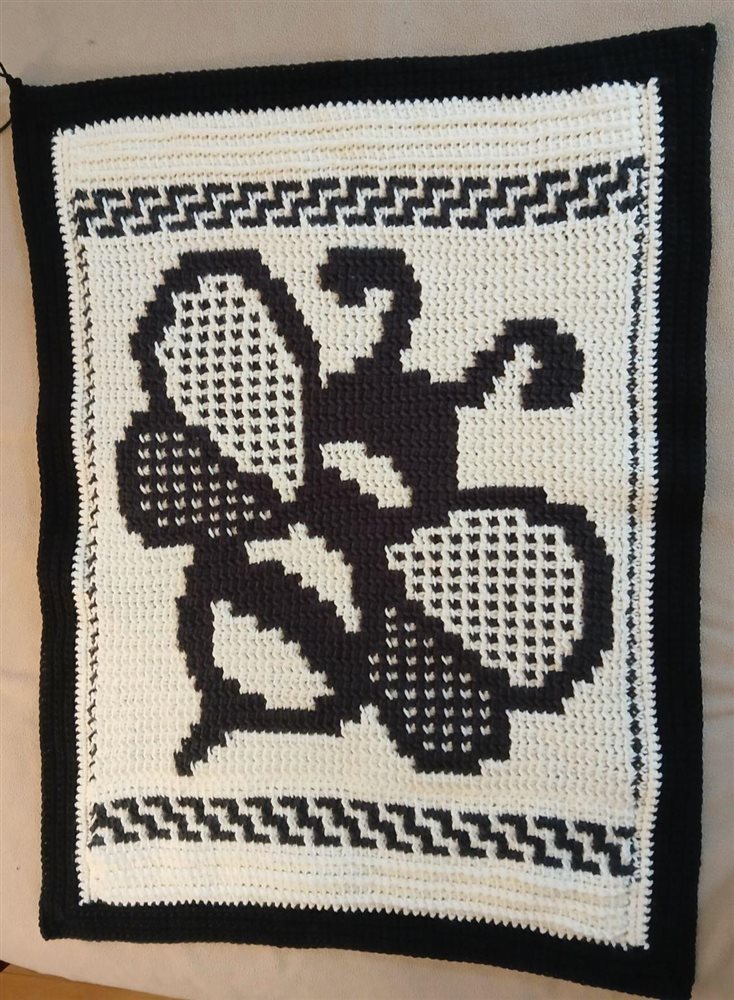
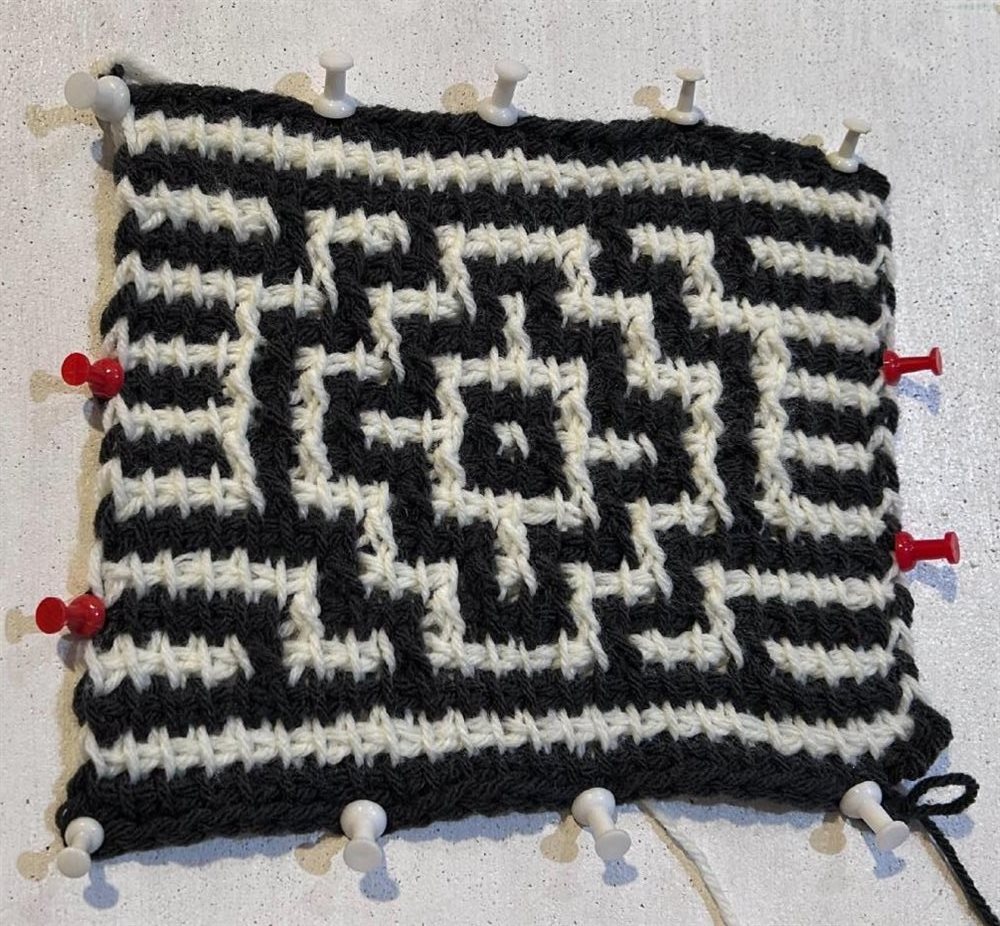
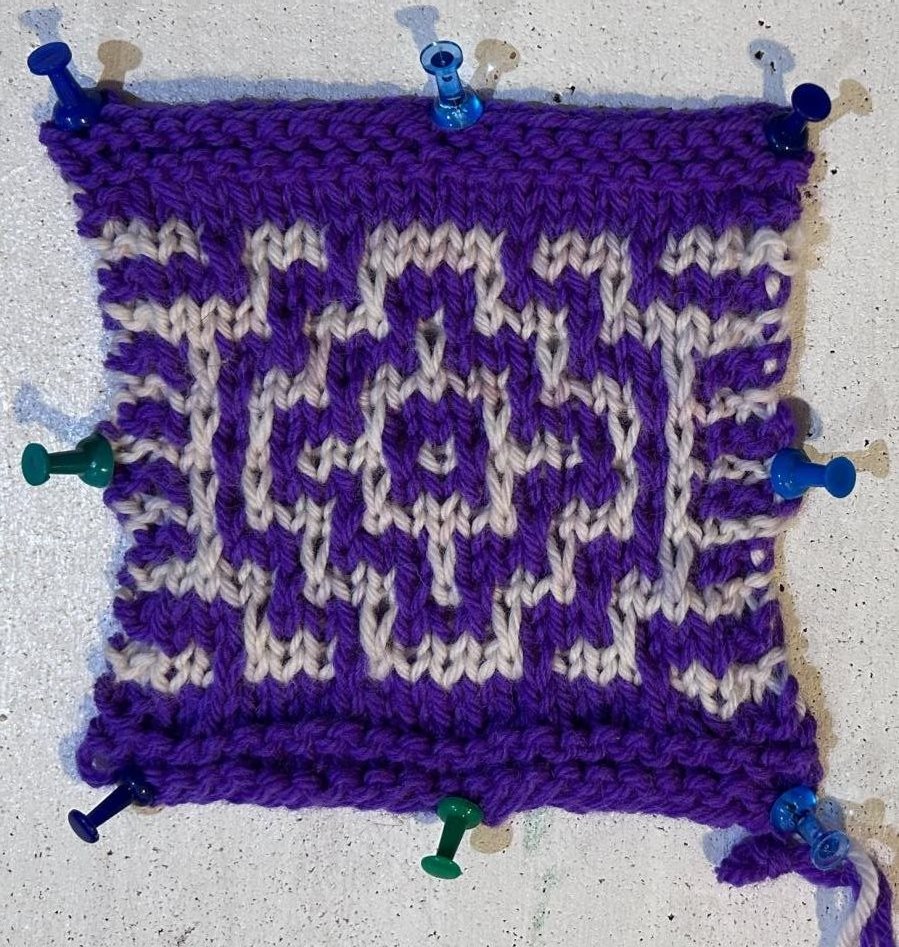
MoYa is written in JavaScript, HTML, and CSS. All data stays on the user's computer, and no AI is used at runtime. (Generative AI assisted in writing MoYa.) It is ongoing work, and feedback is welcome.
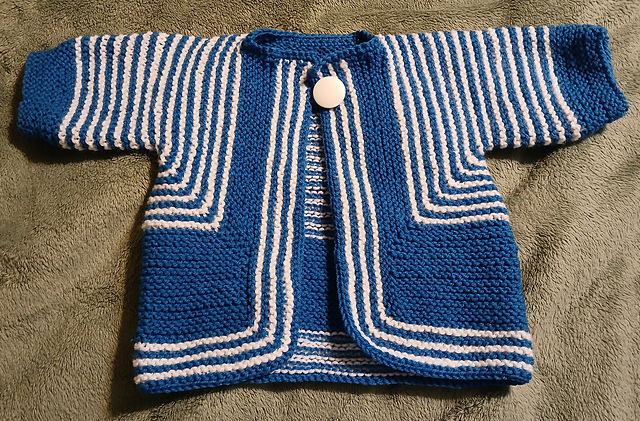
The Surprise Jacket is knit "flat" -- although it doesn't lie flat! -- in one piece, entirely in garter stitch. The cast-on edge becomes shoulders and wrists, and the bindoff forms hem and placket. Off the needles it is an odd, wavy, unrecognizable shape, with multiple mitered increases and decreases. When it is folded it forms a boxy jacket. There are only two seams, from shoulder to wrist. I chose the stripe patterns on my BSJs to showcase the unusual construction.
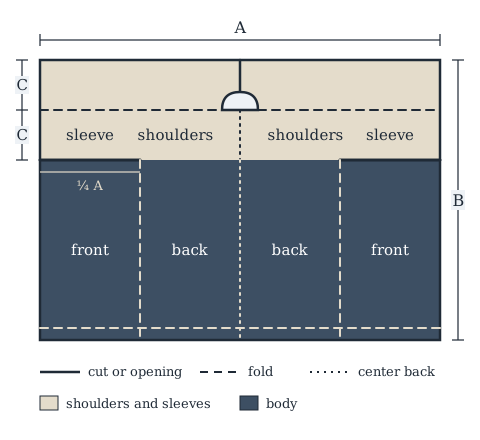
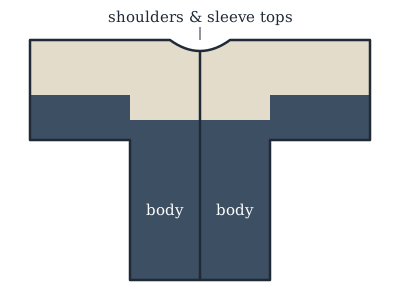
Even simpler than the Surprise Jacket: essentially a garter-stitch square, with stitches set aside for the armholes and neck, then folded at key points and joined. This is a popular pattern for sewing, as it can be cut from a single rectangle of fabric with minimal waste. (Want to Make)
I haven't made a Bog Jacket yet, so the diagrams below are for illustration.
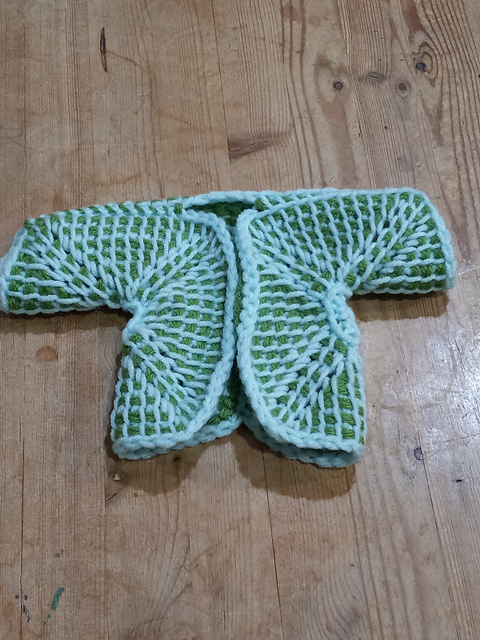
The whole jacket is one huge "circle," worked around and around itself. It is named for the ouroboros, a snake biting its own tail. With Debbie New's keep-going-until-it's-big-enough construction, it works at any gauge and in any yarn. Her original is knitted; my small samples translate the concept into Tunisian crochet and into granny stitch. Alternating two colors was perhaps the worst possible choice for showing the construction of the granny-stitch sample, so when I make a full-sized one I'll give color layout more thought.
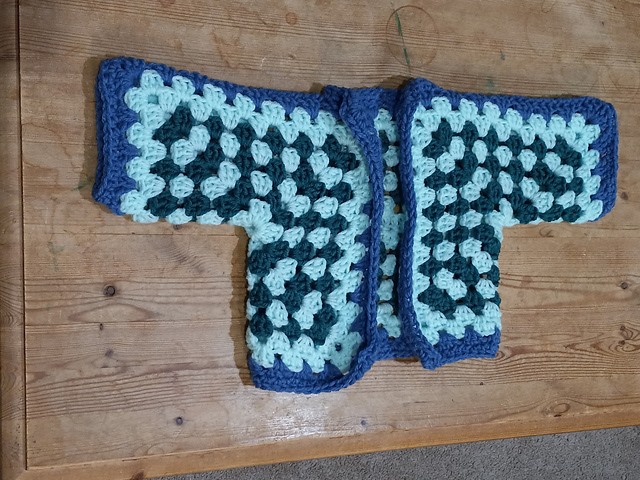
Kristin Omdahl's original is crocheted lace, built from hexagons: a six-petal pineapple motif makes one full hexagon for the back, and partial hexagons form the left and right fronts. The garment's shape comes entirely from the geometry of the seams and folds.
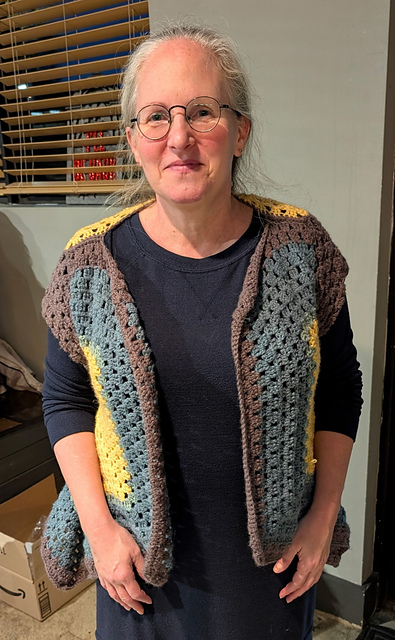
My version keeps that hexagon construction but replaces the lace with granny stitch. It was inspired by a version that YarnAndy wore in a video. Hers was mostly solid-colored; I used more colors because I think they show the construction more clearly.
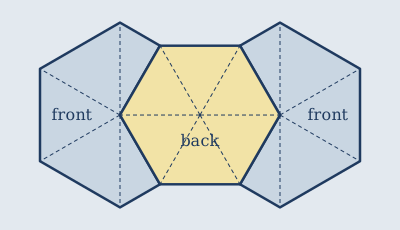
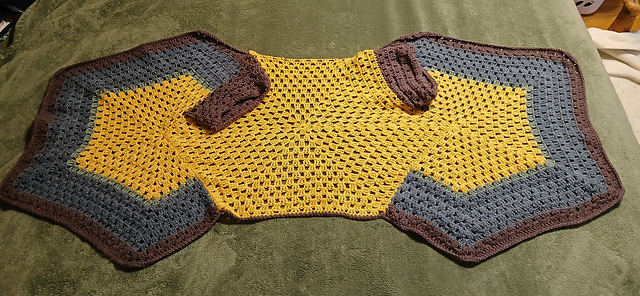
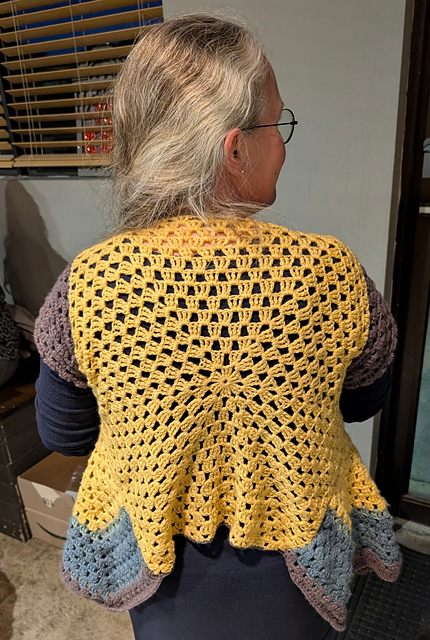
Worked in one giant loop with a large number of right-angle turns, this looks nothing like a sweater until it's shaped and seamed. Figuring out how to assemble it is part of the challenge. (Want to Make)
This starts as an octagon that doesn't lie flat because every corner is a right angle. It folds into a pair of pants. (Want to Make)
Bigger and bigger... (Want to Make) Customizable pattern here: https://demonstrations.wolfram.com/KnittingHyperbolicPants
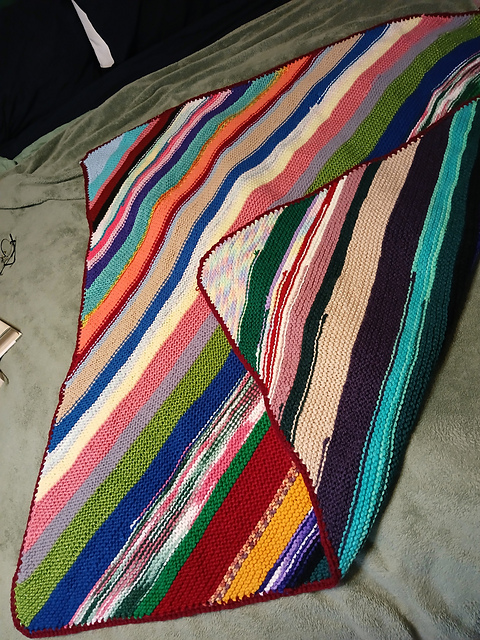
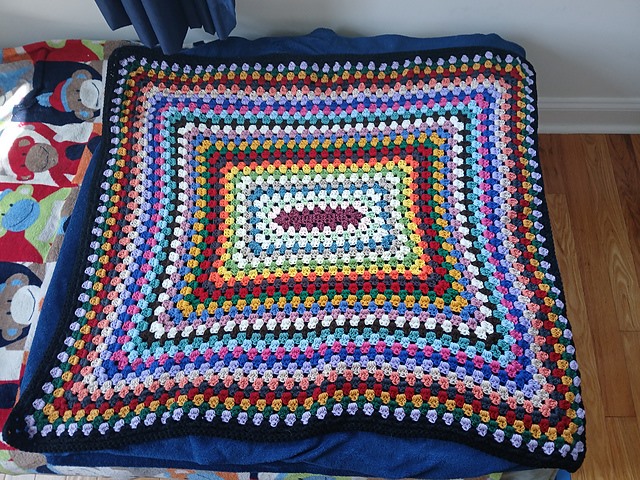
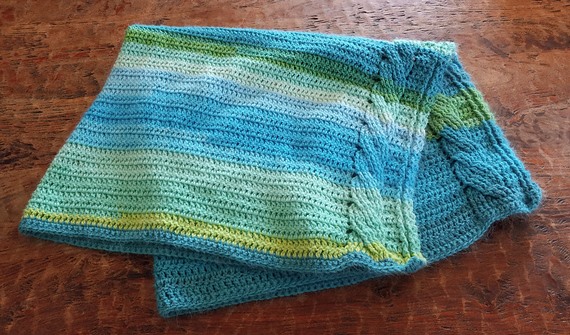
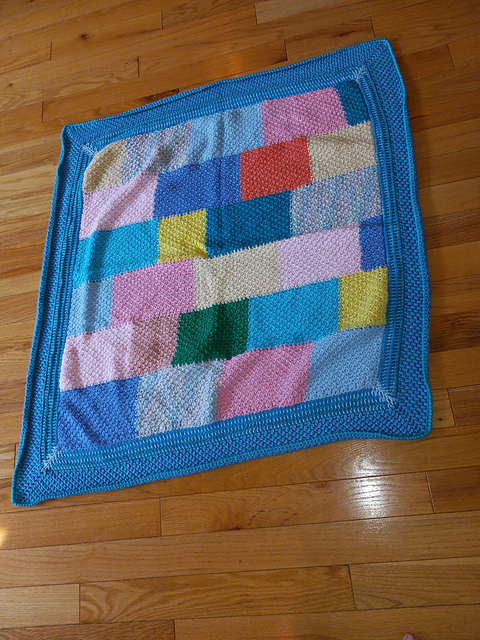
Some of the blankets I've made for Project Linus: